
Take me to SCFAI

After Visit

Once your Launch visit is complete, you will enter the next phase of the program, Food Challenges.

Common Questions

What do I need to know about preparing dosing at home?

Sourcing foods
As you move through the program we will offer our recommended brands for foods. For consistency, during dosing we recommend you stay with one brand. Manufacturers do sometimes change their processes and labels, so it is always good practice to check labels of the foods you are purchasing.
GRINDING TOOLS
There are a lot of nut grinding options available. Some of our families have had success with the Ninja Chop Express (Target/Amazon).
MEASURING TOOLS
When measuring by teaspoons, it is important to have consistency and accuracy. We have found that not all measuring spoons are consistent. Our recommended tools for this reason is the Baker’s Dozen Measuring Spoons (Bed Bath & Beyond/Amazon).

Preparation 101

NUT GRINDING
In preparation for at-home dosing after your Launch visit, please watch the following video about how to prepare ground dosing once your child reaches teaspoon measurements. After washing, drying, and assuring no cross contamination, thoroughly grind the nut into 1 1-2 millimeter size granules. Spoon measurements are performed using loosely filled spoons (no packing of the granules) followed by removing the excess material above the spoon lip with a flat side of a knife. It is better to under dose than to overdose with the spoon.
DENATURING MILK
If your child will be treated for a milk allergy, the following video may be helpful to review in preparation for our program.
EGG SEPARATION
If your child will be treated for an egg allergy, the following videos may be helpful to review in preparation for our program.

A Day in TIP

What does a typical day look like in TIP™?

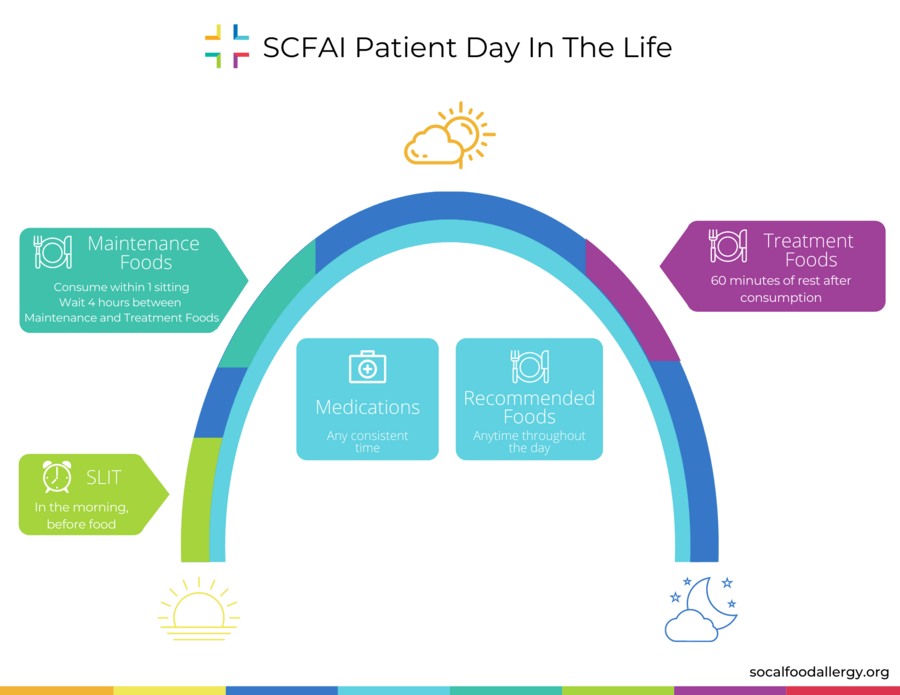
In the morning after teeth brushing, use SLIT (if indicated). After the waiting period, eat all maintenance foods for breakfast. Some patients will make these foods into a cookie, bread, muffin, or pancake. Give recommended foods for snacks or with lunch. Finally, give treatment foods around dinner time followed by the rest period. Medications can be given anytime of day as long as it is consistent, but often before bedtime is convenient. With extra curricular activities where you child is participating in sports or other physical activities it is generally better to do treatment foods after their activity. Remember, your goal for successful treatment is 80-100% compliance. Missing a dose once in a while is acceptable.
What food terminology do you use?

Recommended foods
Recommended foods are pre-conditioning foods that are considered safe foods that your child can have at anytime throughout the day and should be having at least 3-5 times a week. Most recommended foods include apples, pears, and stone fruits or pitted fruits. These fruits can be fresh, frozen, or died. A serving size of these fruits should be an amount equal to your child’s fist size. For the fruits to be useful they may not be cooked, baked, or heated. The skins of the fruits are important to include. Although there are many stone fruits to choose from, the most useful ones for the treatment of your child include cherries, apricots, peaches, nectarines, plums, and olives. Other pitted fruits such as mango and dates are not as helpful as the other choices for pre-treatment. Bartlett or Anjou are preferable choices for pears.
 
Maintenance foods
Maintenance foods are foods that your child has challenged in the clinic and passed. These foods should be eaten every morning. The minimum amount of this food is listed in you maintenance foods.

Your child can have more than this minimum amount unless it is capped. Capped foods mean that your child should consume exactly this much, no more and no less.
 
Treatment foods
Treatment foods are foods in your child’s food dosing strategy. Your child will be introduced to these foods in small amounts in a monitored setting in the clinic. You will then dose them at home in increasing amounts over the course of approximately 4-8 weeks between visits. While at home, these foods should be given in the afternoon or evening, at least 4 hours apart from Maintenance foods. After dosing these foods your child will require a 60 minute rest period.

How can I help my child be successful in TIP™?

Tips
Younger patients can be temperamental when trying to get them to complete their challenges. For some patients coming in hungry but not ‘hangry’ can be helpful. Bringing safe foods and food textures that they are familiar with is helpful. You know your child best, perhaps consider scheduling extra challenge days in the event your child has an off day. Some families also incorporate positive incentive reinforcement to help motivate their child.
 
Emotional support
If you or your child have experienced a significant reaction in the past, as most of our families have, it is important to acknowledge the fear and anxiety that goes hand in hand with these events. It is important to validate those fears and talk with your child about how the TIP™ approach to treatment is different and how safety is our number one priority as early as possible. In age appropriate children, helping them understand why they are doing this is an important key to their long-term success. In some cases, it might be easier for your child to talk with a counselor or therapist about these feelings. For some of our school age patients, connecting with other patients in our program of similar age can be a useful way to support them through treatment. Having all of the family involved in your child’s foods can also help normalize their day to day treatment.
 
Creativity
Our TIP™ families are some of the most creative parents, because they understand how hard it is to have a child with food allergies. Making or trying different foods and rotating food preparation is important to mitigate food fatigue.

How long will my childs treatment take?

Since each child’s plan is individualized based on their data, treatment length will vary. Maintaining compliance throughout the program will help your child achieve food freedom as quickly and safely as possible.