Take me to SCFAI

Purpose

The Launch visit allows our providers to collect your child's data, create their individualized dosing strategy, and make recommendations to prepare their system for food immunotherapy.

Planning My Visit

Treatment Zones

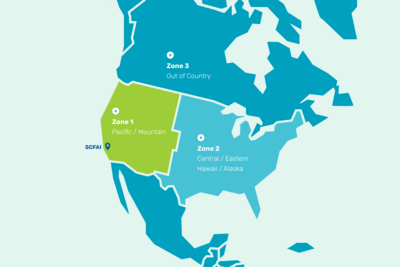
Depending where you live, your treatment plan may differ. Please determine which zone you live in to learn more about how this program can best serve you and your family.

ZONE 1
Pacific/Mountain. With convenient access to our clinic, local patients can easily take steps in the direction towards food freedom.
ZONE 2
Central/Eastern and Hawaii/Alaska. Whether traveling by plane, train, or automobile, we create a plan that fits your child’s needs, regardless of distance.
ZONE 3
Out of country. Even across borders, we will create a plan that fits your child’s needs, regardless of distance.

How TIP™ Works

Endotype

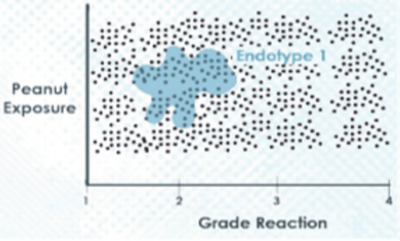
By studying hundreds of biomarkers across thousands of food allergy patients, each endotype (or phenotype) from food allergy patients helps us understand the amount of food allergen required to trigger clinical anaphylaxis in patients bodies.

The Snapshot

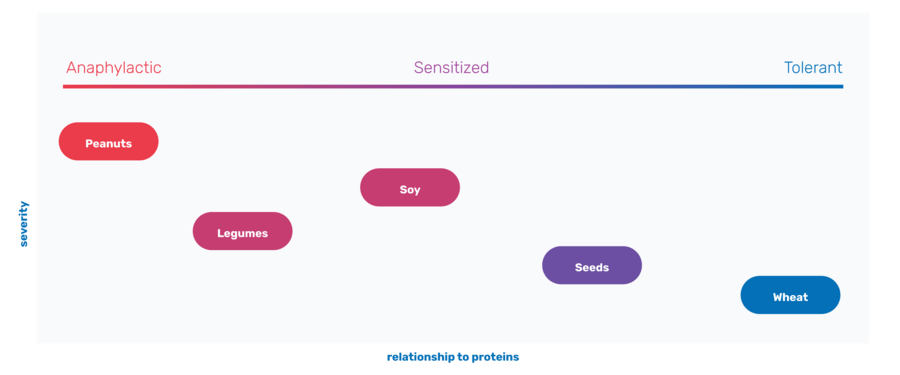
The snapshot is a graph that uses hundreds of biomarkers from your child’s evaluation. We analyze nearly a trillion data points to subtype or endotype your child’s case to determine severity and relationship of allergic proteins that affect your child.

Why are some foods in both columns?
Columns are represented as a percentage. Based on your child’s analysis, some foods may not clearly fall in one group. For example, if “seeds” is 20% sensitized, the bar will be 20% in the sensitized column and 80% in the tolerant.
How do I read my snapshot?
 
ANAPHYLACTIC
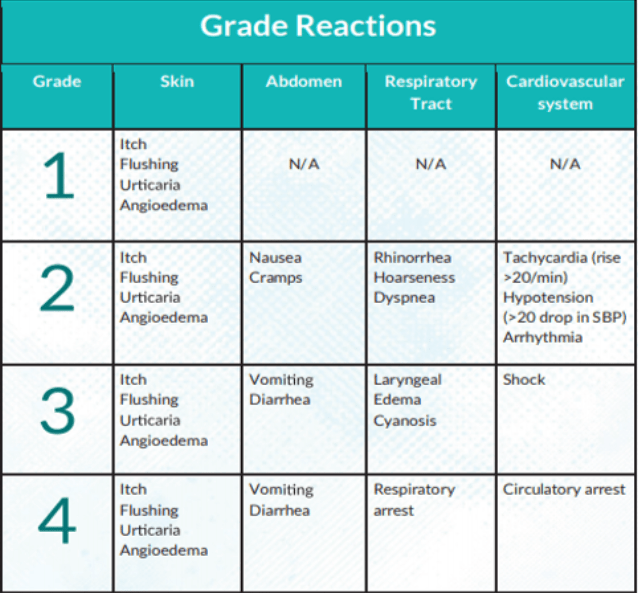
If a food falls into the anaphylactic column, it means that if your child eats that food at a very small amount, your child has a 95% chance of suffering a grade 2 reaction. A grade 2 reaction involves 2 body systems.
 
SENSITIZED
If a food falls into the sensitized column, it means if your child eats that food at a larger amount their immune system will produce allergic pathways and proteins in their blood. Foods on the right side of sensitized column can likely be consumed with no clinical reaction. However, food on the left side of the column are at higher risk to cause a grade 1 reaction, or have a 1 system involved reaction.

 
TOLERANT
If a food falls into the tolerant column, it means that a large, infrequent ingestion of that food will not activate the allergic pathways of your child’s immune system. This is the goal of treatment, to move all foods to this column.

Grade Reactions

The snapshot is a graph that uses hundreds of biomarkers from your child’s evaluation. We analyze nearly a trillion data points to subtype or endotype your child’s case to determine severity and relationship of allergic proteins that affect your child.

Will we receive new snapshots throughout the program?
We are still working on the ability to produce updated snapshots for patients as they move through the program based on repeat lab analysis.
 

Pre-Treatment

PRESCRIBED MEDICATIONS
Zofran is a medication used to treat nausea. Prednisolone is a liquid oral steroid. Ora-Pred is a dissolvable oral steroid used to prevent prolonged or biphasic allergic reactions. Tagamet is a liquid histamine-2 blocker. Epi-Pen and Auvi-Q are epinephrine autoinjectors used in the treatment of anaphylaxis.
 
RECOMMENDED FOODS
Pre-treatment will include a recommended diet of foods, some of which your child likely already eats in a set amount 3 3-5 times per week.
 
SLIT
Pre-Treatment may also include targeted treatment (specific to your child’s case) of environmental allergies utilizing Sublingual Immunotherapy (SLIT). SLIT is a safe and effective approach that has been used to treat environmental allergies for over 60 years.

Conditioning

Conditioning involves passing “high dose” challenges of foods which are in the sensitized column on your child’s snapshot. After safely passing challenges to these foods that contain key proteins such as albumins, you child’s “food cluster” is pulled toward the tolerant column. Treating with these biosimilar proteins pulls more anaphylactic proteins away from the anaphylactic column and into the sensitized column. Making treatment of these proteins safer and more successful.

Tolerance Induction

Using complex data analytics and statistics, your child will undergo tolerance induction for the proteins they are anaphylactic to. The first dose is introduced in the clinic at SCFAI and every subsequent dose is administered at home. Passing every up-dose predicts your child’s ability to pass the next up-dose, eventually leading to a full challenge pass. No guesswork is done here, your child’s data analysis predicts their path to success. Once a challenge is passed, you child will eat a maintenance dose of that food for a period of time until their blood work reveals tolerance. At this point, daily dosing will start to space out to a less frequent exposure.

Remission

Remission is achieved when food allergens are moved to the tolerant column. This means your child will only have weekly maintenance dosing and can eat food safely whenever they want without restrictions or the need to read labels.